

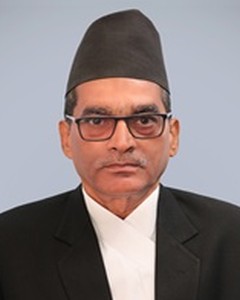
Hon'ble Justice · माननीय न्यायाधीश
Abdulajeej Musalman
अव्दुल अजीज मुसलमान
Appointed 20 December 2023 (2080-09-04 BS)
2 years 10 months of service
Cases heard and decided
Benches including Justice Abdulajeej Musalman, from the date of appointment to 30 October 2026 (2083-07-13 BS). Cases decided: by a judgment or final order. Median days to decision: half of the cases took less time from registration, half took more (about 1 year 7 months). Cases listed: listed for hearing at least once. Per year: an average over the length of service. Definitions.
Biography
- Date of birth
- Not published by the Supreme Court
- Age
- Not published by the Supreme Court
- Mandatory retirement
- Not published by the Supreme Court
- Entered the judicial service (न्याय सेवा प्रवेश)
- 10 June 2013 (2070-02-27 BS)
Career
Not published by the Supreme Court
Source: Supreme Court of Nepal: list of justices (name and photograph); Annual Report 2081/82, Annex 97, page 291 (dates of appointment and of entry into the judicial service). Checked on 2 November 2026 (2083-07-16 BS).
Time to decision compared with all benches
Time to decision is the number of days from a case's registration at the Supreme Court to its judgment or final order. The median is the middle value: half of the cases took less time and half took more. Each bar shows the middle half of cases decided; the mark on the bar is the median.
For benches including this justice, the middle half of cases were decided between 193 and 1,672 days after registration. For all benches over the same period, the median was 564 days and the middle half took between 186 and 1,726 days.
Time to decision depends heavily on the kinds of cases a bench is assigned, which the justices do not choose, and on how long those cases had already been pending.
Year by year
Cases decided each year
Median time to decision each year
Show the figures for each year
| Fiscal year | Cases decided | Median time to decision (days) | All benches (days) | Judgments written |
|---|---|---|---|---|
| 2080/81 (2023/24) – part year | 830 | 1,317 | 821 | 128 |
| 2081/82 (2024/25) | 1,525 | 598 | 696 | 379 |
| 2082/83 (2025/26) | 916 | 447 | 368 | 155 |
| 2083/84 (2026/27) – part year | 201 | 429 | 242 | 1 |
Judgments written
Counted from the 1,201 judgments of benches including this justice in which the published text names the justice who wrote the judgment. The writing justice is named in about half of all published texts, and in more than four in five of those from 2080/81 onwards.
Judgments written each year
Analytics
The same measures, worked out the same way, for each of the 17 sitting justices. Beside each figure is the figure for all benches over the same period, and where the justices fall. The figures describe the benches on which Justice Abdulajeej Musalman sat, not the justice's own vote. They are not a judgement of any justice's work. How these are worked out.
What happened when cases were listed
Each time a case appears on a bench's cause list, the court records what happened. Shares of 19,666 listings before benches including this justice, and of 157,029 before all benches over the same period.
No result was recorded for 24% of this justice's listings (18% for all benches); they are left out of the shares. “Not reached” means the bench did not get to the case that day; how many cases are listed each day is set by the court's roster.
Show the figures
| Result | This justice's benches | All benches | Range among the justices |
|---|---|---|---|
| Decided (judgment or final order) | 17.7% | 19.0% | 12.0% – 21.3% |
| Interim order | 8.8% | 10.5% | 7.5% – 15.5% |
| Adjourned | 15.4% | 14.5% | 12.7% – 21.4% |
| Not reached | 46.7% | 44.0% | 33.2% – 51.2% |
| Cannot hear | 6.2% | 8.8% | 5.9% – 12.9% |
| Bench did not sit | 1.7% | 1.9% | 0.0% – 3.4% |
| Other | 3.5% | 1.3% | 0.4% – 3.5% |
Definition, source and gaps
- What it counts
- Every listing (one case on one bench's cause list on one day) from the justice's appointment, by the result the court recorded.
- Source
- Supreme Court cause lists and hearing records, 1 August 2016 to 30 October 2026.
- Gaps in the record
- No result recorded: 24% of this justice's listings (10% to 25% across the justices). Some listings name no justices and cannot be counted for anyone.
- Comparing justices
- Every justice on a bench is counted for the bench's listings; most benches have two justices. Compared with all benches over the same period, because practice changes from year to year.
Cannot hear (हेर्न नमिल्ने)
Each circle is one of the sitting justices, compared with all benches over that justice's own period; the filled circle is this justice. Names are not shown.
On two-justice benches: 5.4% with this justice; the same colleagues on two-justice benches without this justice: 8.0%.
By fiscal year
Show the figures for each year
| Fiscal year | Listings with a result | Cannot hear, this justice's benches | Cannot hear, all benches |
|---|---|---|---|
| 2080/81 (2023/24) – part year | 5,693 | 6.1% | 9.5% |
| 2081/82 (2024/25) | 8,893 | 6.1% | 8.1% |
| 2082/83 (2025/26) | 4,537 | 5.9% | 9.3% |
| 2083/84 (2026/27) – part year | 543 | 10.3% | 5.9% |
“Part year” marks the year of appointment and the current year. “Too few”: fewer than 300 listings with a result.
Definition, source and gaps
- What it counts
- Listings for which the bench recorded that it cannot hear the case (हेर्न नमिल्ने). This is the proper course when a justice has a conflict of interest, for example in a case that a justice on the bench handled earlier as an advocate or decided earlier in a lower court. The case is then listed before another bench.
- Source
- Supreme Court cause lists and hearing records, 1 August 2016 to 30 October 2026.
- Gaps in the record
- The court records no reason: none of the 47,735 such listings carries a remark. The entry belongs to the bench, so it does not say which justice could not hear the case. Linked cases are often listed together, so a few days can account for many listings.
- Comparing justices
- The colleague comparison holds the colleagues fixed, not the cases: the same case is often declined by more than one bench.
Adjourned (स्थगित)
Each circle is one of the sitting justices, compared with all benches over that justice's own period; the filled circle is this justice. Names are not shown.
Who asked, as recorded: a party or its lawyer 76%, the government attorney 3%, because of a linked case 21%.
Definition, source and gaps
- What it counts
- Listings recorded as adjourned (स्थगित).
- Source
- Supreme Court cause lists and hearing records, 1 August 2016 to 30 October 2026.
- Gaps in the record
- Who asked for the adjournment is recorded for almost every one.
- Comparing justices
- Most adjournments are asked for by the parties' lawyers, so this reflects the cases before the bench as much as the bench.
Time to decision
Each circle is one of the sitting justices, compared with all benches over that justice's own period; the filled circle is this justice. Names are not shown.
Definition, source and gaps
- What it counts
- Days from registration at the Supreme Court to the judgment or final order, for the 3,472 cases decided by benches including this justice; each case counted once.
- Source
- Supreme Court cause lists and hearing records, 1 August 2016 to 30 October 2026.
- Gaps in the record
- Decisions before 1 August 2016 are not in the records.
- Comparing justices
- Depends on the kinds of cases a bench is assigned and on how long they had been pending; justices do not choose their cases.
Appeals decided
How the lower court's decision fared, for 1,444 appeals decided by benches including this justice and 12,359 by all benches over the same period.
Upheld is not better or worse than reversed. The records rarely say who appealed (the prosecution or the accused, for example), so they cannot say which side a result favoured.
Show the figures
| Outcome | This justice's benches | All benches | Range among the justices |
|---|---|---|---|
| Upheld | 78.1% | 74.7% | 65.1% – 79.9% |
| Partly reversed | 9.1% | 8.6% | 5.9% – 15.1% |
| Reversed | 7.5% | 10.2% | 5.5% – 16.9% |
| Sent back to a lower court | 2.6% | 3.1% | 0.6% – 5.8% |
| Other or not classified | 2.6% | 3.4% | 1.1% – 11.6% |
Definition, source and gaps
- What it counts
- Final decisions in appeal cases (case codes CR, CI, RB and RC), by the decision type the court recorded. Each case is counted once.
- Source
- Supreme Court cause lists and hearing records, 1 August 2016 to 30 October 2026.
- Gaps in the record
- Not classified: 3% of this justice's appeals. The appellant is named in the records for only about one criminal appeal in ten.
- Comparing justices
- The mix of criminal and civil appeals differs between benches.
Writ petitions granted (रिट जारी)
Each circle is one of the 15 justices whose benches decided at least 100 writ petitions, compared with all benches over that justice's own period; the filled circle is this justice.
Definition, source and gaps
- What it counts
- Final decisions on writ petitions (case codes WO, WC, WH, WS and WF) recorded as granted (जारी), in full or in part.
- Source
- Supreme Court cause lists and hearing records, 1 August 2016 to 30 October 2026.
- Gaps in the record
- Not classified: 5% of this justice's writ decisions. Habeas corpus orders are often recorded differently and may be under-counted.
- Comparing justices
- Writ petitions differ widely in subject, and a bench's share depends on which petitions it is assigned.
Leave to appeal or review granted (अनुमति हुने)
Each circle is one of the 17 justices whose benches decided at least 100 applications, compared with all benches over that justice's own period; the filled circle is this justice.
Definition, source and gaps
- What it counts
- Applications for leave to appeal or for review (case codes RI, LE, RV and NF) recorded as granted (अनुमति हुने).
- Source
- Supreme Court cause lists and hearing records, 1 August 2016 to 30 October 2026.
- Gaps in the record
- Nearly all are classified.
- Comparing justices
- Leave granted means the case goes on to a full hearing; it is not a decision on the merits.
Corruption cases (भ्रष्टाचार)
Each circle is one of the 14 justices whose benches decided at least 50 corruption cases, compared with all benches over that justice's own period; the filled circle is this justice.
Outcomes are not shown: the records do not say whether the prosecution or the accused appealed, and the result changes with the definition used.
Definition, source and gaps
- What it counts
- Cases of the kinds the Commission for the Investigation of Abuse of Authority (CIAA) prosecutes: corruption, bribery, illicit enrichment, false certificates and misappropriation of public property. Banking offences and money laundering are not included.
- Source
- Supreme Court cause lists and hearing records, 1 August 2016 to 30 October 2026.
- Gaps in the record
- Identified by the case type registered at the court; the prosecuting body is not recorded.
- Comparing justices
- Corruption appeals are few for each justice and are assigned by roster.
Benches
Each circle is one of the sitting justices, compared with all benches over that justice's own period; the filled circle is this justice. Names are not shown.
Size of bench
Sat most often with, on 662 two-justice sittings
- Dr. Nahakul Subedi53 (8%)
- Kumar Regmi51 (8%)
- Balkrishna Dhakal50 (8%)
- Hari Prasad Phuyal47 (7%)
- Binod Sharma45 (7%)
- Tek Prasad Dhungana43 (6%)
- Other sitting justices251 (38%)
- Justices since retired122 (18%)
Definition, source and gaps
- What it counts
- Sittings (one bench on one day) on which this justice was named: the cases listed per sitting, the number of justices on the bench, and the colleague on each two-justice sitting.
- Source
- Supreme Court cause lists and hearing records, 1 August 2016 to 30 October 2026.
- Gaps in the record
- The court's bench-type field is filled for only 18% of listings, so the size of a bench is counted from the names listed. The same sitting is sometimes written in two ways in the records; these are counted as one.
- Comparing justices
- The Chief Justice sets the rosters; justices do not choose their benches or colleagues.
Records to 30 October 2026 (2083-07-13 BS). Each justice is counted from the date of appointment, so the figures for justices appointed in 2025 cover a shorter period.
These figures describe the benches on which Justice Abdulajeej Musalman sat, not the work of the justice alone. Corrections are welcome by WhatsApp at +977 976-8630501 or by email at inquiry@jawafdehi.org. About the data.